Talk, talk, chat, chat, please!
The arrival of those first words is a long-awaited, touching, and sometimes slightly stressful moment for a parent. It’s normal to be eager for your little one to start talking so you can leave the cooing phase behind. As adorable as it is, this stage is a little more abstract. First words, on the other hand, often bring excitement, and sometimes relief. To better understand what’s going on in this wonderful adventure, here’s an overview of language development and simple ways to support your child every day.
Language development: a natural process
Well before they say their first words, your child is already communicating a lot. These are their first tools for connecting with you:
- An exchanged glance;
- A knowing smile;
- A gesture to show an object;
- Rhythmic babbling;
- A little arm stretched out to ask for something.
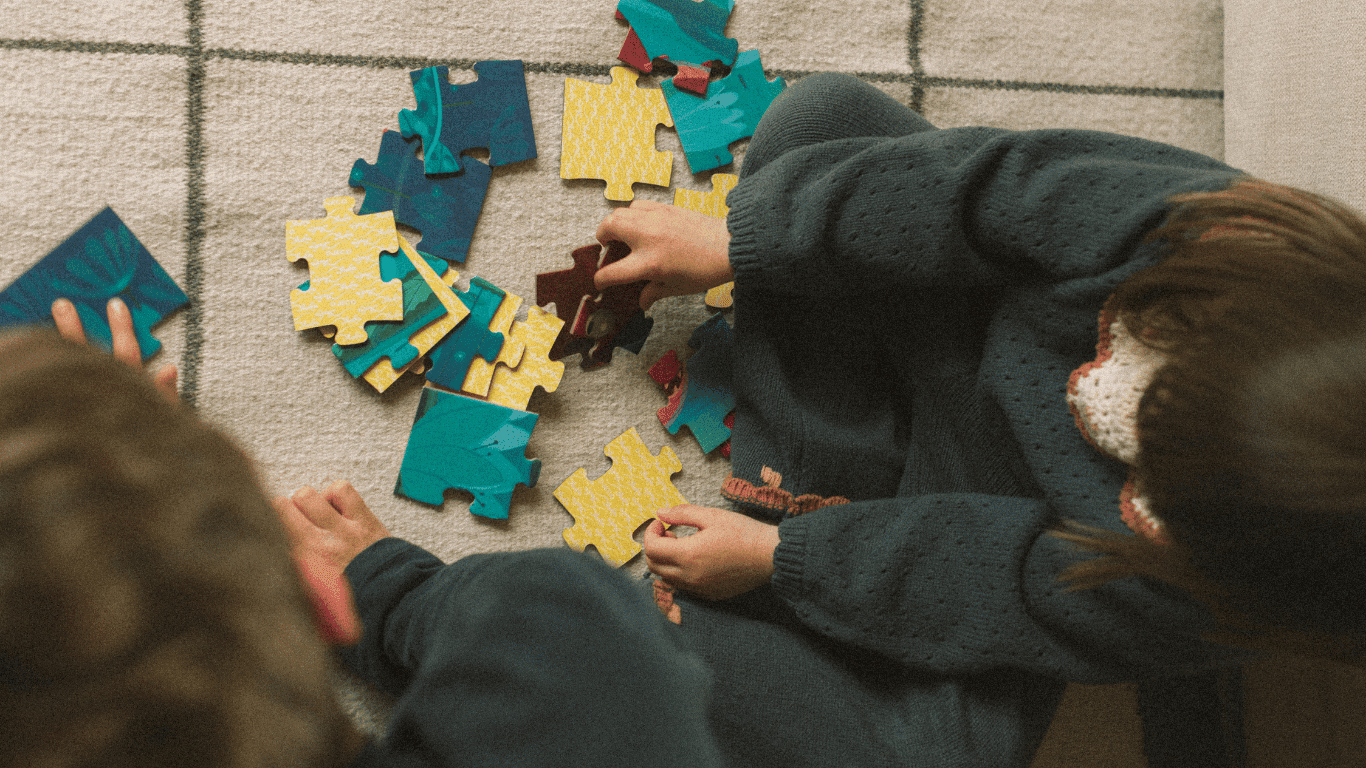
These behaviours are the first pieces of a vast puzzle: language. They come together slowly and prepare the ground for the arrival of first words. Then one day, a word appears. And another, then another. The puzzle takes shape. Later, two words are combined… and eventually, a short sentence followed by “why?” repeated 47 times.
Language is built mainly through natural everyday interactions: during bath time, when getting dressed, or during an impromptu dance in the living room. No need for Pinterest-inspired activities. Or sophisticated educational toys. Routines not only help the day move forward, but also offer golden opportunities to connect.
Your little one’s brain works wonderfully well. Their senses are true superpowers of learning. The more your child has a concrete experience, the easier it is for their brain to retain the words associated with it. For example, when they encounter a cat, they see it, touch it, and hear it. Your child builds a complete image of the word cat and better encodes what the word means: it’s soft, it goes “meow,” it has a tail, four legs, and whiskers. This multisensory exploration makes the word alive and concrete for them—and therefore much easier to memorize.
Why stimulate early?
From the first few months, your mini’s brain is in “recording” mode. That’s why we say children are like sponges: they absorb (absolutely) everything: sounds, gestures, intonations, and all the elements needed to understand and communicate. Stimulating early doesn’t mean doing more or aiming for performance: it’s more about being present, speaking naturally, and responding to their attempts to communicate, by creating a rich and warm environment.
A word or what?
One morning, your child might say “mamamamamamama” while looking at the ceiling, and you might hope to hear a very first word. They’re probably not actually saying their first “mama” (I know, it can be disappointing), but stay patient, it’s coming! It’s usually babbling, a very important stage where your child explores the sounds of language.
A few days later, you’re doing downward dog on your mat and you hear a “mama” directed right at you, accompanied by a little finger pointed your way… Hallelujah!
We can consider that a child says a (real) word when it is:
- Spontaneous (not said in repetition);
- Intentional;
- Contextualized (used at the right time to refer to the right thing).
A (real) word can take several forms:
- A sign (like showing “all done” with their hands);
- An approximation—often very charming (e.g., “ni” for all done);
- A more social production (e.g., “bye bye!”);
- An animal sound (e.g., “miaw” for cat);
- An onomatopoeia (e.g., “vroom” for car).
First words are often related to your child’s daily life : close people, familiar objects, simple actions.
In my example where you were doing your morning yoga, your child finally said “mama” to refer to their mom… and your heart probably melted like snow in the sun.
Okay, and when do words appear?
First words usually appear between 12 and 16 months.
After the emergence of first words, your little one gradually builds their vocabulary. The number of words then increases rapidly: this is the vocabulary explosion, a stage (it’s aptly named) that occurs between 18 and 24 months. This is also when we see the first combinations (e.g., “don’t want,” “more yoga :P,” etc.).
Then, between 2 and 3 years old, children start to associate 2 to 3 words and make little sentences.
How to stimulate without (too much) complication?
Here are simple, effective strategies you can apply right away:
- Follow your child’s interest
Listen and observe what interests them; let them lead the dance. A red truck? Perfect. Talk to them about the red truck (e.g., “The red truck is going fast!” ; “Vroom vroom, it’s going to put out the fire!”). - Position yourself at their height and face them
It’s much more inviting to talk to a face than to legs. Above all, by seeing your face, they can better see your mouth and expressions—it helps a lot. - Talk about what you’re doing, what they’re doing, and what you see
Simple narration in real time. No need to be a poet. Just describe what’s happening. You see a bird together, you can say: “Look, the bird is flying!” You’re cooking with your child, you can tell them: “I’m cutting the carrot; you’re stirring the sauce.” - Imitate what they do
You show that you’re interested in them and encourage the exchange. - Rephrase their messages, without asking them to repeat
You become a bit like their linguistic GPS, showing them the right way. For example, if your child says “doggy gone,” you can respond “yes, the doggy is gone.” - Add one or two words
This little “extension” helps them move to the next stage. For example, if they say “truck,” you can respond “a red truck!” - Model difficult words, without asking them to repeat
Little tricks, big impact: Repeat the words they’re trying to say correctly, emphasizing the sounds that are harder for them, without asking them to repeat after you. For example, if they say “papi” for carpet, you can respond “yes, the CArpet,” stressing the “ca.” You can slow down your speech, point to your mouth, and place objects (when possible) near your face. - Use humour
Children learn by having fun. No need to be a rising comedian for your child to find you funny: a silly gesture, an exaggerated sound, or a colander on your head are more than enough. - Give them time
After speaking to them, wait a good 5 seconds. Yes, it may seem long, but this pause will allow them to process the information and then take their turn in the communication. - Read books
You can describe what you see in the pictures, following what your child is looking at. No need to read the story word for word. Nor is it necessary to have a fully stocked library. Children love to reread the same stories. - Play
Yes… play. With them, of course. Play is the best natural learning ground for a child.
A little reminder
Every little gesture helps.
Every shared glance builds communication.
Every babble announces a word to come.
Every moment becomes an opportunity to learn.
The more you observe, listen, play, talk, laugh, and tell stories… the more words will naturally find their place and join the conversation.