Understanding Your Baby's "Flat Head"
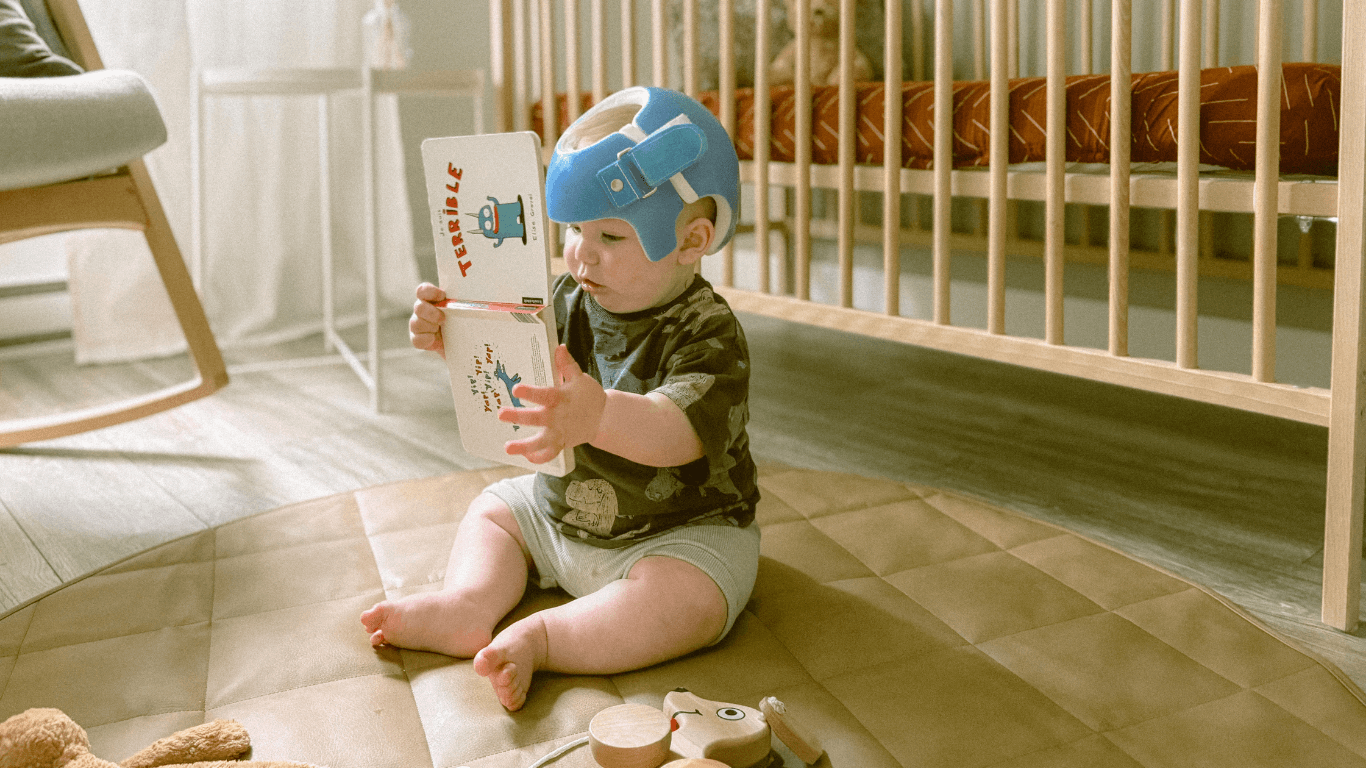
Positional plagiocephaly is a deformation of an infant's head that shows up as a flattening on one side of the back of the skull. It is often called "flat head." This condition is common in babies and is considered benign. It is not painful and does not affect brain development.
Why does it happen?
At birth, a baby's skull is naturally extremely soft. You could compare it to modelling clay: if you press it in the same place, it will slowly flatten. At this stage, the bones are not yet fused, to allow for one extremely important thing: the rapid growth of the brain during the first year of life. However, this softness also makes the head more sensitive to repeated pressure, and when a baby spends a lot of time with their head resting on the same side on a firm surface, such as a mattress or seat, an area of the skull can gradually flatten.
Is positional plagiocephaly common?
Yes. Positional plagiocephaly affects a large number of infants. We're talking about 16% at six weeks, 19.7% at four months, 6.8% at 12 months, and 3.3% at 24 months.1It is more common today, mainly due to the important recommendations to put babies to sleep on their backs to reduce the risk of sudden infant death syndrome. This sleep position remains essential and safe.
Which babies are most at risk of having "flat head"?
Some babies are more likely to develop plagiocephaly, for example those who often turn their head to the same side (commonly called a head preference), those who spend a lot of time on their backs when they are awake, or those who tolerate being on their stomachs poorly. A postural preference of the neck or neck stiffness (torticollis) can also contribute to the appearance or maintenance of the deformation.
Can it harm my child?
Let me reassure you right away. In the vast majority of cases, positional plagiocephaly is mainly aesthetic. However, it should be addressed and positioning strategies should be put in place. Otherwise, it can be accompanied by neck stiffness or asymmetries in movements.
As a parent, what can I do on a daily basis?
Positioning habits early in life play a key role. Tummy time play, when the baby is awake and under supervision, helps reduce the time spent with the head resting. Varying the baby's positions during the day, changing the orientation in the bed, the changing table, alternating the side the head is turned to during play are simple and effective strategies. It is also recommended to limit the time spent in equipment where the head remains immobile, such as car seats, swings, and shells when not necessary.
As a parent, it is also important to pay attention to how you carry your baby. Is their head always turned to the same side? We often tend, without realizing it, to always adopt the same position.
These small adjustments can make a real difference. Varying positions helps prevent congenital torticollis, a condition often linked to plagiocephaly, while promoting a more harmonious development of your child.
When should I consult a professional?
It is advisable to consult a healthcare professional if the shape of the head does not improve, if the asymmetry seems to be getting worse, or if the baby almost always turns their head to the same side. Early assessment by a physiotherapist usually allows for faster improvement and a shorter period of care. The physiotherapist is trained to intervene with this type of condition and will be able to give you all the recommendations to apply in addition to carrying out a detailed assessment of your child's neck.