My child is afraid of Halloween: how can I gently support them?
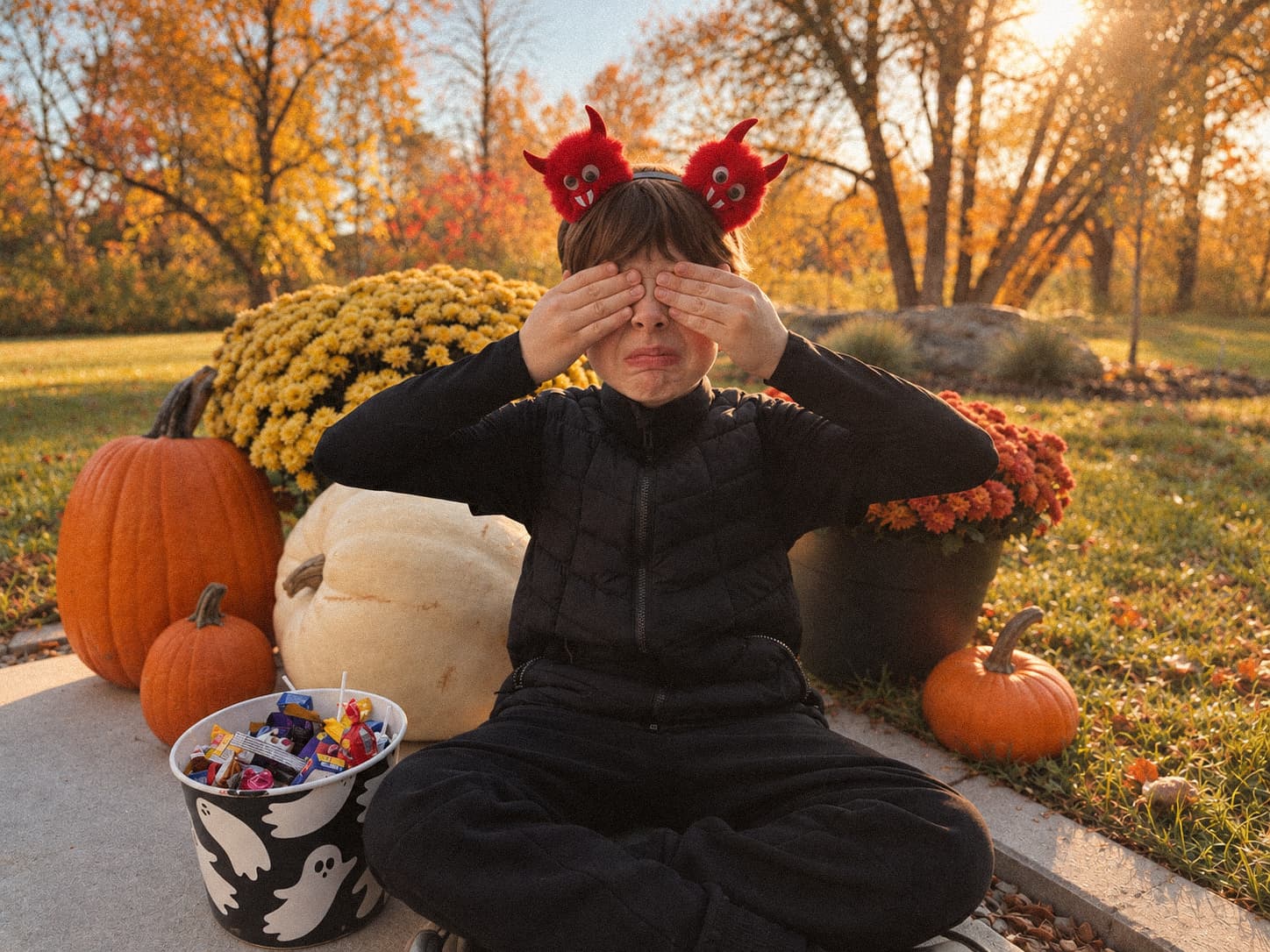
Ah, autumn! A mild, cool, and colourful season, but also host to the famous festival of fear: Halloween! For many children, Halloween is synonymous with festivities and fun, and the excitement begins well before October 31. They choose their costume, decorate the house, talk about trick-or-treating, and count the days. However, for others, the monsters, witches, skeletons, masks, noises, and decorations can trigger a real sense of fear.
A whole fantasy world suddenly takes over homes, shops, and sometimes even daycare centres or schools. With our rational adult eyes, these decorations designed to scare may seem rather harmless. For our child, however, the experience can be quite different. So, how can we compassionately support our child and allow them to participate in this celebration without minimizing their fear, but also without making avoidance the only possible strategy?
Why is my child afraid?
Sources:
- American Academy of Pediatrics. Fears & Phobias in Children: How Parents Can Help. HealthyChildren.org.
- American Academy of Pediatrics. Help Your Child Manage Anxiety: Tips for Home & School. HealthyChildren.org.
- American Academy of Child and Adolescent Psychiatry. Anxiety and Children. Facts for Families.
- American Academy of Child and Adolescent Psychiatry. Anxiety and Children. AACAP.
- American Academy of Child and Adolescent Psychiatry. Frequently Asked Questions: Anxiety Disorders. AACAP.
- American Academy of Child and Adolescent Psychiatry. Practice Parameter for the Assessment and Treatment of Children and Adolescents With Anxiety Disorders. Journal of the American Academy of Child and Adolescent Psychiatry.
- American Academy of Pediatrics. Halloween Fun & Safety Tips for Kids of All Ages. HealthyChildren.org.
- Baumel W, Strawn J. Neurobiology of Treatment in Pediatric Anxiety Disorders. Child and Adolescent Psychiatric Clinics, 2023; 32, 589-600.
- Bouchard, C. et Fréchette, N. (2011). Le développement global de l’enfant de 6 à 12 ans en contextes éducatifs. Québec, Québec : Presses de l’Université du Québec.
- Bourque, Solène. Les grandes émotions des tout-petits : comprendre et soutenir les apprentissages émotionnels chez les 2 à 6 ans. Québec, Éditions Midi trente, 2020, 139 p.
- Clavere, A. (2024). Contre la douleur, l’anxiété et la déprime… des câlins ! Cerveau & Psycho, 166(6), 6-7. https://doi.org/10.3917/cerpsy.166.0006.
- Centre jeunesse de Laval (2000). Grille de développement de l'enfant 0-18 ans et des activités favorisant son évolution. Laval, Québec : Direction des services aux jeunes et à leurs familles - Le service des Ressources.
- DiMaggio, D., MD, FAAP. Easing Babies & Toddlers into Halloween Fun: 8 Tips for Parents. American Academy of Pediatrics.
- Faire face à ses peurs. Université d'Exeter, 2018. https://www.santemonteregie.qc.ca/sites/default/files/2023/01/faire_face_a_ses_peurs_final_cr_compressed.pdf
- FILLIOZAT, Isabelle. Au coeur des émotions de l’enfant. Vanves, Marabout, 2013, 322 p.
- Même pas peur ? Les phobies de l’enfant et de l’adolescent. (2015). Enfances & Psy, (65), https://shs.cairn.info/revue-enfances-et-psy-2015-1?lang=fr.
- National Scientific Council on the Developing Child. Persistent Fear and Anxiety Can Affect Young Children’s Learning and Development. Centre on the Developing Child at Harvard University.
- Simard, H., et l’équipe de la clinique spécialisée des troubles anxieux du CHU Sainte-Justine. Les_troubles_anxieux_chez_l_enfant_et_ l_adolescent.pdf.
- Société canadienne de pédiatrie. Helping children deal with their fears. Caring for Kids.
- Walter, H. J., et coll. (2020). Clinical Practice Guideline for the Assessment and Treatment of Children and Adolescents With Anxiety Disorders. Journal of the American Academy of Child & Adolescent Psychiatry, 59(10), 1107-1124.