


When will your baby sleep through the night?
The first few nights with a baby are often far from restful. You’re probably eager for your baby to “sleep through the night.” Few expressions are as familiar to parents and their loved ones as a baby who “sleeps through the night.” The frequency of this expression almost gives the impression that sleeping through the night is a universal milestone that all parents eagerly await, which can put pressure on you, especially when you’re tired.
What does “sleeping through the night” mean?
A baby who “sleeps through the night” can mean different things to different people. Some seem to define it as when your baby starts to stretch out their consecutive hours of sleep at night, while for others, it might mean sleeping 10 to 12 hours without waking up. In a study of parents with babies, parents associated “sleeping through the night” with a period of sleep that resembles the definition of a real night, not just a block of a few hours between midnight and 5 a.m. Parents expected a much longer period of sleep, closer to their own definition of a real night.
Your expectations as a parent also play an important role in how you interpret your baby’s sleep. For example, if you believe a baby “should” sleep for a long time, every wake-up can be seen as a problem.
In fact, “sleeping through the night” mainly means you don’t need to intervene, or very little, during a relatively full night, and this, for most nights. In other words, your baby can have short nighttime awakenings without it being a problem. In this definition, what makes your baby not yet sleeping through the night is mainly when the awakening requires your intervention (e.g., feeding, holding, rocking, presence) and this happens over a prolonged period.
A quick reference: 24-hour sleep needs
TheAmerican Academy of Sleep Medicine provides a general framework for the number of hours of sleep a child should get based on their age. The recommendations are very similar in Canada.
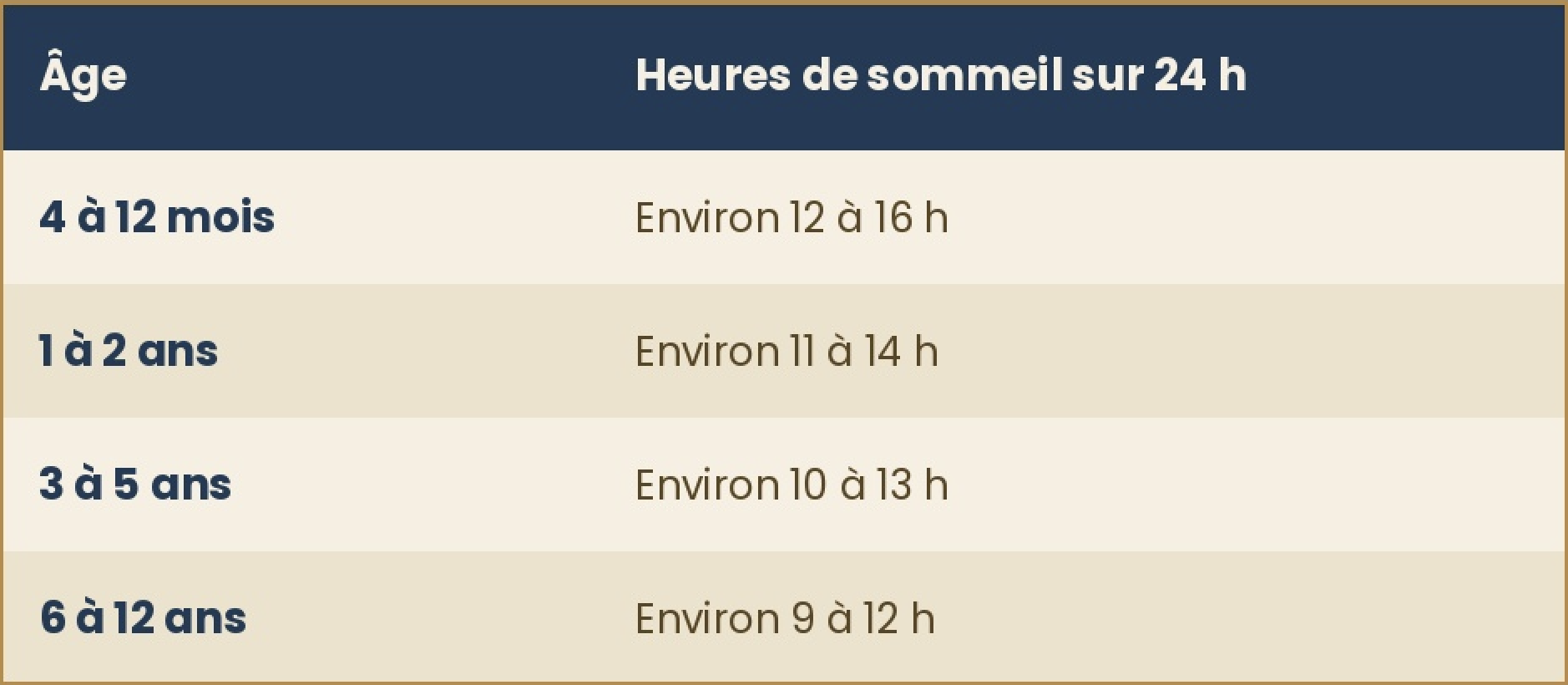
Since these figures include both nighttime sleep and naps, it doesn’t mean a 6-month-old baby should sleep 12 to 16 hours in one block at night. So even with these recommendations, it’s not clear exactly how many hours your baby should sleep at night. These benchmarks can help you get a sense of where you’re at, but they don’t tell you at what age a baby should “sleep through the night.”
How many hours of sleep should a baby get?
By observing your baby, you can learn to recognize their sleep needs, which naturally change as they develop.
- From 0 to 2 months: Sleep is still very immature
For most babies, the first few weeks of life are quite unpredictable when it comes to sleep. With fragmented nights and the fact that your baby doesn’t seem to distinguish between day and night, you probably feel your child is far from “sleeping through the night.” This is normal. Although some babies start to sleep a little more at night very early on, this is generally not yet the time to measure sleep with the goal of “sleeping through the night.” The goal here is rather to try to meet your child’s needs, in terms of sleep and otherwise, and to get through this somewhat chaotic period with the support you need. - From 2 to 4 months: The first long blocks of sleep
Around 6 to 8 weeks, you may have noticed that your baby is starting to sleep a little more at night, and that their longest block of sleep often occurs at the beginning of the night. Despite this progress, the stability of sleep from night to night doesn’t yet seem to be established: the progress your baby makes in terms of sleep can seem fragile and changeable from one night to the next. Similarly, the second half of the night can remain more disorganized. It’s encouraging when longer blocks start to settle in, but their absence doesn’t mean there’s a problem because there’s still a lot of variability from night to night, and between babies. - 4 months: Sleep reorganizes
Four months is an age often mentioned when it comes to sleep, particularly with what’s called the 4-month regression (reference to the article written by Marie-Pierre – Sleep Regressions) . This expression is often used to describe babies who were sleeping well until then, with a long block or even all night, but who suddenly start waking up more often. This is often linked to sleep reorganizing and sleep habits. Although some babies sleep through the night at 4 months, this isn’t the norm, so don’t worry if this isn’t the case for your baby. - From 4 to 6 months: Better understanding nighttime awakenings
With the sleep reorganization that often occurs around 4 months, you may find that your baby starts to follow a slightly more predictable sleep schedule, with more stable naps and longer and longer night blocks. Some babies may still need to feed at night depending on their weight, growth, daytime feeding, or medical context. At this age and depending on the child, some awakenings are linked to a need to feed, while others are more linked to a need for help falling back asleep. Some babies will start to sleep through the night during this period. If this isn’t the case for your baby, you can start to observe the nature of your child’s awakenings during the night. Is your baby really feeding well during all these awakenings? Is he or she mainly looking for your presence or comfort? Is your baby sometimes able to fall back asleep without help? These observations will help you better understand your child’s needs and know how to address them to promote their sleep and yours. - From 6 to 12 months: Nights become more and more consolidated
For many healthy babies who are growing well, feeding well during the day, and developing typically, we can start to expect nights without frequent parental intervention from 6 months. At this age, we can see a consolidation of sleep, but it often builds gradually. Sleep varies greatly between babies, but also from night to night. One good night doesn’t mean everything is settled, and a series of full nights followed by a bad night doesn’t mean everything is lost.
In fact, we often see a lot of variability from night to night. So yes, it’s possible your baby will sleep through the night at this age, but it’s also possible he or she won’t yet sleep through every night. However, sleep should become more and more consolidated during the second half of their first year. In general, your baby should need less help during the night, even if it’s not perfectly stable. - 12 months and over: What if nights remain difficult?
Although your baby may still have short awakenings, sleep should be fairly consolidated and stable from night to night at this age. What’s worth observing is mainly whether the awakenings are frequent, long, accompanied by crying, or require a lot of intervention. At this age, persistent awakenings can sometimes be linked to how the child falls asleep at bedtime. If they always fall asleep with a lot of help, they may look for the same help during nighttime awakenings.
Adjusting how they fall asleep can sometimes reduce interventions during the night. That said, if the awakenings are very frequent, have been going on for several weeks, if your baby is hard to soothe, or if the fatigue is becoming too much for you, it may be worth talking to a healthcare professional or someone trained in baby sleep. While not every night has to be perfect, the goal is sleep that allows your baby and you to recover sufficiently, both physically and mentally.
“Sleeping through the night”: Beyond a good or bad night
When you have a bad night with your baby, you may feel overwhelmed and want to understand why the night was so difficult. It’s normal to look for explanations. However, one night alone doesn’t always give a good picture of your baby’s sleep. It will be more helpful for you to observe the trends that emerge, what repeats itself from day to day, and what evolves from week to week.
For example, you can ask yourself: Compared to last week, are the awakenings becoming less frequent? Is your baby sometimes able to fall asleep or fall back asleep without help? Does he or she seem well, alert, and in a good mood during the day? Are you also managing to recover some energy?
Of course, the question “Is he sleeping through the night?” often comes from a good place. People ask because they want to check in with you, see if the nights are difficult, and offer some empathy if you’re sleep-deprived. This well-meaning intention can have even more impact if it opens the door to what you’re really experiencing, rather than seeking to know if your baby meets a certain expectation. So we could ask: “How are the nights going these days?” because behind this question, there’s often another one: “Are you getting some sleep too?”
Marie-Pierre Gosselin,
M.A., Special Education Teacher, Child Sleep Consultant, Mom of 3 (twins +1)

